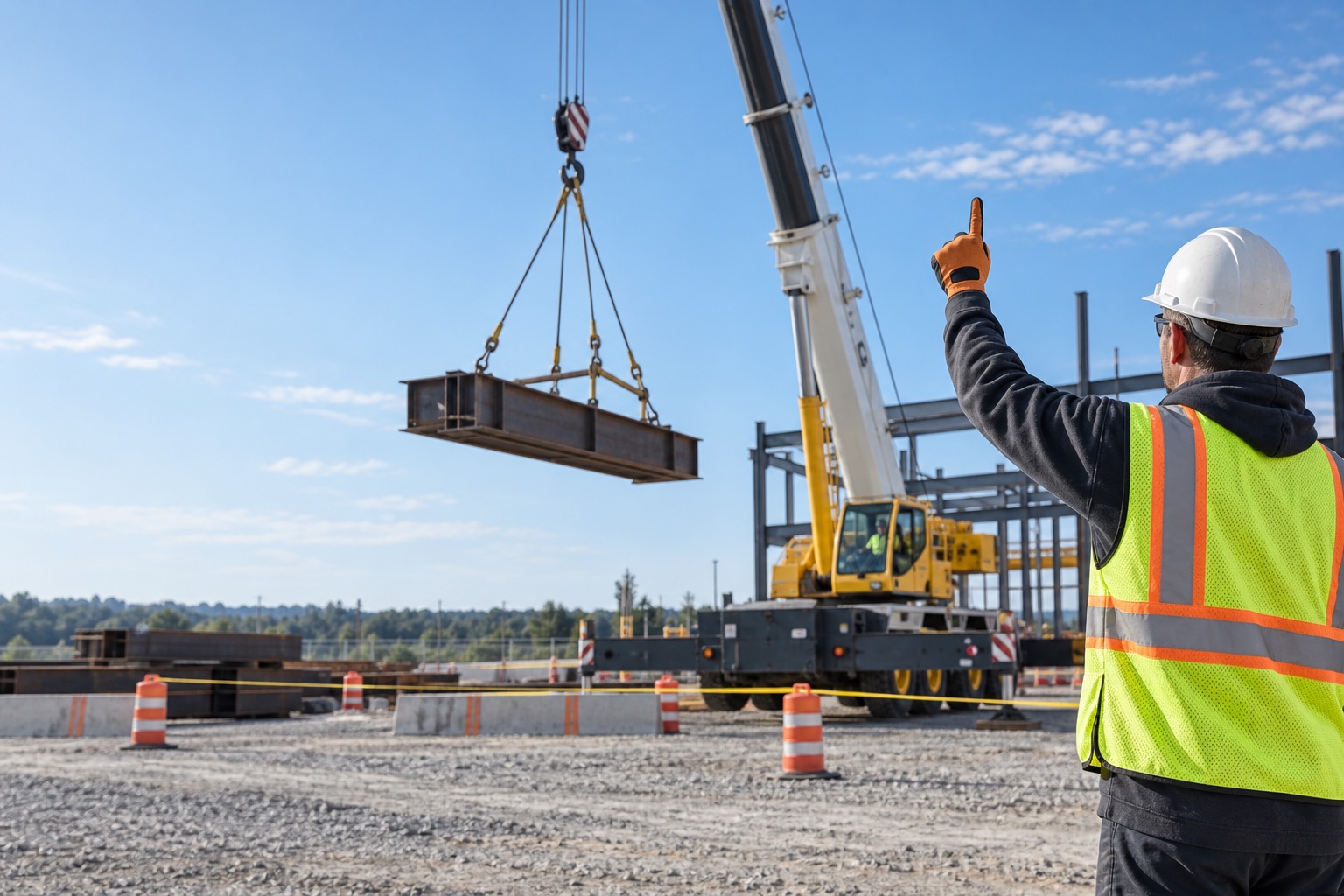
Clear signals protect people, loads, and equipment. Learn when signaling is required, how OSHA's Standard Method works, how voice and radio systems are controlled, and when every movement must stop.
~236 minutes 7 modules · 24 lessonsOSHA Subpart CC
LanguagesEnglish and Spanish available · Russian in preparation
CompletionAwareness completion record
Communication is a control
Prevent one unclear signal from becoming uncontrolled motion.
A suspended load can move after the signal ends. The course connects hand, voice, and radio rules to crane dynamics, blind lifts, operator perspective, load paths, swing radius, power lines, and changing jobsite conditions.
Every module keeps the legal boundary clear: awareness supports safer participation, while assigned signal persons still need the OSHA-required evaluation, practical test, documentation, and employer verification.
Learn OSHA Appendix A signal families and use the posted official chart for exact performance.
03
Communicate without ambiguity
Apply voice order, radio testing, dedicated-channel, identification, and lost-communication rules.
04
Stop unsafe movement
Protect load paths, fall and swing zones, power-line clearance, and every worker's stop-alert right.
Planning tools
Construction Plan Studio
Use the calculator to document the communication plan, work area, load-path notes, and responsible roles before a qualified person authorizes the lift.
Planning support only. A qualified person or engineer must review the final plan, current conditions, equipment data, and work method.
Course outline
Six modules. Eighteen field-focused lessons.
221 lesson minutes + 15-minute assessment
01
Signal-person role and OSHA boundaries
Know when signaling is required, who controls the lift, and why awareness training is not practical qualification.
Where Subpart CC signaling applies~9 min
When a signal person is required~10 min
Qualification, documentation, and reassessment~9 min
02
Crane movement and communication planning
Understand basic crane motion, load behavior, operator perspective, and the communication plan for blind lifts.
How crane movement affects the load~10 min
Direction, position, and visibility~10 min
Plan a blind lift~10 min
03
OSHA Standard Method hand signals
Recognize the OSHA Appendix A signal families and use the official posted chart for exact reference.
Stop, emergency stop, hoist, and lower~14 min
Boom, swing, and telescoping signals~14 min
Combined, slow, hoist-selection, and travel signals~12 min
04
Voice, radio, audible, and non-standard signals
Set a predictable protocol, test communication, prevent competing messages, and stop when clarity is lost.
Build a compliant voice command~10 min
Test and protect electronic communication~10 min
Audible, new, and non-standard signals~10 min
05
Lift-zone hazards and stop-work decisions
Keep people clear of suspended loads, control swing and power-line risks, and respond to changing conditions.
Load path, fall zone, and work-area control~10 min
Power lines and dedicated spotter awareness~10 min
Weather, ground, traffic, and unexpected change~10 min
06
Pre-lift practice, scenarios, and completion
Apply the rules to realistic lifts, document concerns, and understand the next step toward qualification.
Run a practical pre-lift briefing~10 min
Work through realistic signaling decisions~10 min
Assessment and qualification next steps~7 min
07
Applied workplace decisions and verification
Pre-lift review, radio readiness and evaluation records. Six case-based lessons with explanations and knowledge checks.
Handover between signal persons is a controlled change~6 min
Test the radio where the lift will actually occur~6 min
Voice commands need a shared reference~6 min
Landing readiness is more than an empty space~6 min
Qualification evidence must match the signaling method~6 min
A stop must lead to a verified restart~6 min
Required practical evaluation
Complete the field assessment before assignment.
For construction signal-person work, the evaluator must document the signaling types assessed. The printable worksheet supports the required practical assessment but does not replace the employer's or third party's qualification process.
This awareness course does not qualify or authorize a signal person. OSHA qualification requires an allowed qualified evaluator, knowledge testing, a practical test, documentation, and employer verification for the signaling types used.