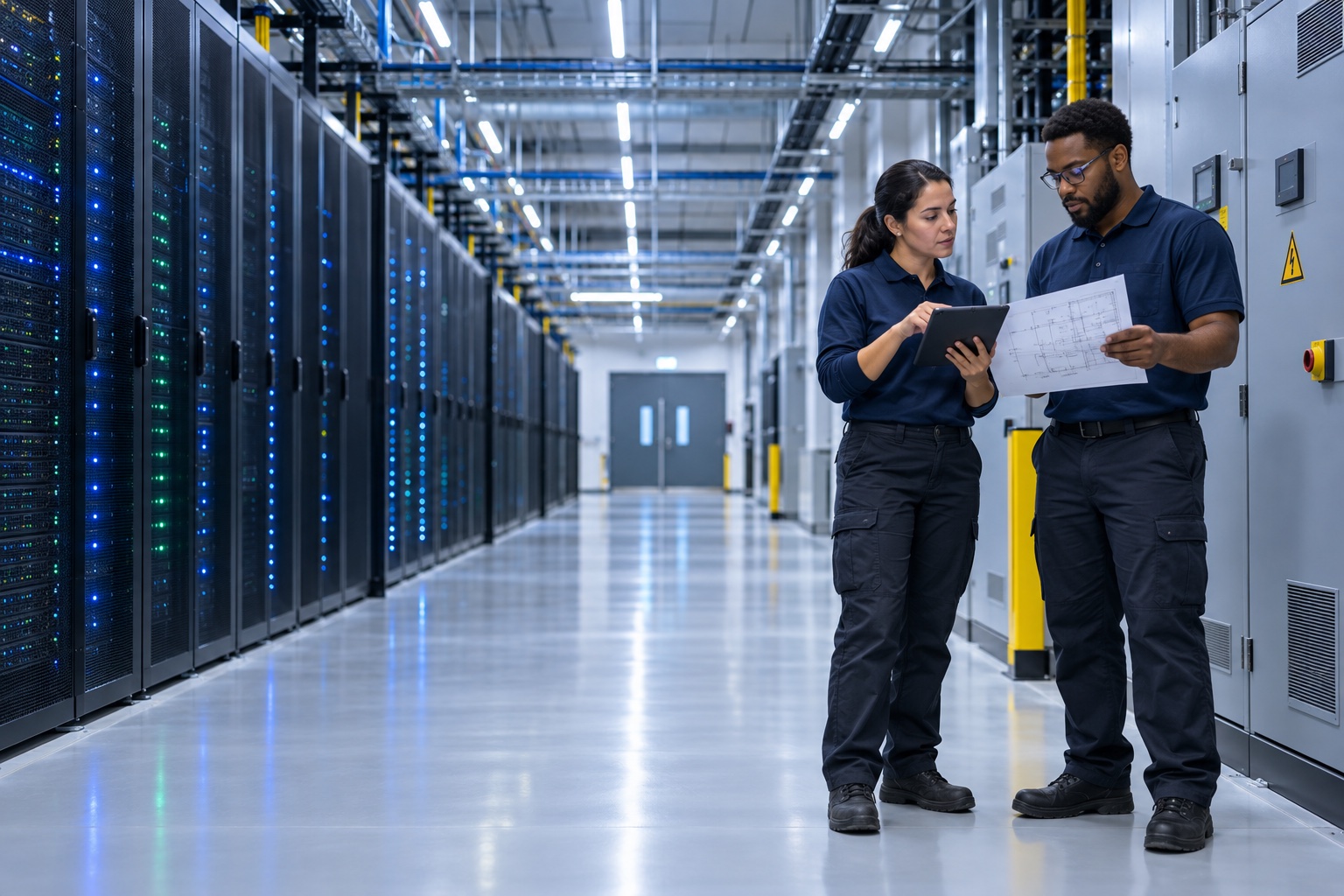
A comprehensive, facility-wide safety course for employees, contractors, vendors, and visitors who enter data centers or support their critical infrastructure.
LanguagesEnglish and Spanish available · Russian in preparation
CompletionVerifiable SafetyFluent completion
Critical operations · human safety
Protect people without losing sight of system interactions.
Data centers combine high-energy electrical distribution, automatic equipment, stored energy, batteries, cooling systems, water, fuel, chemicals, alarms, fire suppression, restricted access, and continuous operations. The safest decision accounts for both the immediate job and the facility state it may change.
The course builds one repeatable decision method: verify authority and configuration, plan the work, identify hazards, choose effective controls, communicate, stop when conditions change, and close out every system deliberately.
Learning outcomes
Recognize. Verify. Control. Escalate.
Practical awareness for routine and nonroutine work.
01
Read the whole facility
Connect critical electrical, mechanical, fire, water, controls, security, and IT systems before acting.
02
Plan controlled work
Use JHAs, approved MOPs, pre-job briefs, hold points, abort criteria, and verified closeout.
Use stop-work, alarm, evacuation, reporting, access control, and emergency boundaries.
ANSI consensus framework
One facility. Several complementary standards.
OSHA requirements remain the regulatory baseline. ANSI standards add recognized, hazard-specific practices; referencing them does not certify this course, a worker, or a data center.
Read the facility as an interconnected electrical, mechanical, fire, water, fuel, controls, and IT system.
Data center infrastructure~13 min
02
Data center safety culture
Use stop-work, reporting, handoffs, and learning systems in a high-reliability environment.
Data center safety culture~13 min
03
Pre-job planning, JHA, and MOP
Turn a scope of work into controlled steps, hazards, approvals, hold points, and recovery actions.
Pre-job planning, JHA, and MOP~13 min
04
Emergency procedures
Recognize alarms, evacuate, communicate, and avoid becoming an unplanned responder.
Emergency procedures~13 min
05
Data center access and security
Enter only authorized areas without defeating safety, security, or emergency controls.
Data center access and security~13 min
06
Confined spaces
Recognize permit-space indicators in tanks, pits, vaults, and other limited-entry areas.
Confined spaces~13 min
07
Slips, trips, and same-level falls
Control temporary cables, packaging, leaks, floor openings, and visibility hazards.
Slips, trips, and same-level falls~13 min
08
Material handling and ergonomics
Move servers, batteries, cable, racks, cylinders, and deliveries without crush or strain injuries.
Material handling and ergonomics~13 min
09
Electrical hazards and arc flash
Recognize shock, arc-flash, grounding, temporary-power, and automatic-transfer hazards.
Electrical hazards and arc flash~13 min
10
Control of hazardous energy
Identify every energy source and understand authorized, affected, and other employee roles.
Control of hazardous energy~13 min
11
Fire prevention and suppression systems
Prevent ignition, preserve detection and suppression, and respond correctly to alarms and impairments.
Fire prevention and suppression systems~13 min
12
Heat hazards and thermal conditions
Separate server inlet limits from human heat exposure and protect workers in hot spaces.
Heat hazards and thermal conditions~13 min
13
Noise hazards
Recognize generator, chiller, fan, and alarm exposure and preserve communication.
Noise hazards~13 min
14
Chemical management and batteries
Use labels and SDSs and recognize refrigerant, fuel, treatment-chemical, and UPS battery hazards.
Chemical management and batteries~13 min
15
Water and cooling systems
Control pressure, chemicals, biological hazards, leaks, and electrical interaction.
Water and cooling systems~13 min
16
Working at heights
Plan ladders, lifts, roofs, loading edges, and overhead work with fall and dropped-object controls.
Working at heights~13 min
17
Housekeeping, closeout, and continuous improvement
Leave the facility in a verified safe configuration and capture lessons before the next job.
Housekeeping, closeout, and continuous improvement~13 min
18
Applied workplace decisions and verification
Work authorization, leak exclusion and shift handover. Six case-based lessons with explanations and knowledge checks.
An approved work plan must match the field~6 min
Remote controls and redundancy are not isolation~6 min
Raised-floor openings need a controlled work boundary~6 min
Water near equipment changes the response boundary~6 min
A contractor handoff needs shared control of the job~6 min
Closeout includes people, alarms and temporary controls~6 min
Awareness and qualification boundary
This OSHA-aligned course incorporates relevant ANSI voluntary consensus frameworks, including ANSI/TIA-942-C, ANSI/ASSP Z10.0, Z244.1, Z117.1, Z359 and Z490.1, and ANSI/ISEA PPE standards. It is not an ANSI/TIA facility certification and does not replace site-specific training, permits, qualified-person duties, electrical qualification, authorized LOTO status, confined-space authorization, equipment certification, emergency-response qualification, or applicable construction requirements. Employers remain responsible for hazard assessment and compliance with federal, State Plan, local, manufacturer, insurer, contract, and authority-having-jurisdiction requirements.