Practical awareness training for hot, cold, wet, windy, indoor, outdoor, mobile, and PPE-intensive work. Recognize exposure, prevent illness, protect coworkers, and respond before a warning sign becomes a fatal emergency.
LanguagesEnglish and Spanish available · Russian in preparation
CompletionSafetyFluent completion record
Built for real work
One decision system for changing conditions.
Air temperature alone cannot describe temperature stress. The course combines heat and cold science with the realities of physical work, protective clothing, new-worker risk, limited recovery, changing weather, indoor processes, vehicle breakdowns, and emergency access.
Examples transfer across industries while preserving an important boundary: each employer must evaluate the actual job and apply current federal, State Plan, local, contract, and industry requirements.
Official field resource
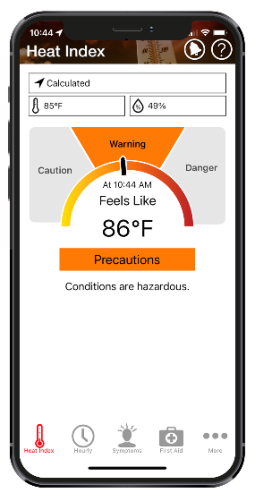
OSHA-NIOSH Heat Safety Tool
Check the current heat index, hourly forecast, precautions, symptoms, and first-aid information before and during outdoor work. The app is a screening aid—not a substitute for WBGT when appropriate, workplace measurements, workload and PPE adjustments, acclimatization, or the employer’s plan.
Official image and app information: CDC/NIOSH. Available from CDC at no charge. NIOSH currently reports that the app is not receiving updates; verify current conditions and guidance.
Learning outcomes
Recognize. Prevent. Respond. Improve.
Every lesson turns knowledge into a workplace decision.
Use source controls, safer schedules, hydration, acclimatization, dry layers, and effective recovery.
03
Recognize and act
Identify warning signs in yourself and coworkers, stop exposure, and escalate without dangerous delay.
04
Learn from real cases
Apply lessons from fatal heat investigations, cold-injury data, mobile work, and industry scenarios.
Course outline
Six modules. Eighteen detailed lessons.
226 lesson minutes + 15-minute assessment
01
Temperature stress fundamentals
Understand body heat balance, job demands, environmental conditions, and why the same day can affect workers differently.
How the body gains and loses heat~9 min
Assess the environment and the job~14 min
Work, clothing, and individual risk factors~9 min
02
Prevent heat illness
Control heat at the source, design safer schedules, provide hydration and recovery, and protect new or returning workers.
Use the hierarchy of controls~12 min
Water, rest, shade, and recovery~12 min
Acclimatize new and returning workers~12 min
03
Recognize and respond to heat illness
Notice early changes, treat altered mental status as an emergency, cool rapidly, and learn from fatal workplace cases.
Heat illness signs and symptoms~10 min
Act quickly without exceeding your training~10 min
Real cases: first-day risk and hidden heat~10 min
04
Prevent cold stress
Plan for wind, wetness, contact, changing conditions, clothing, warm-up areas, vehicles, and cold-storage work.
Where cold exposure becomes dangerous~10 min
Layers, warm-up breaks, and work practices~10 min
Vehicles, remote work, and cold storage~10 min
05
Recognize and respond to cold illness
Identify hypothermia, frostbite, trench foot, and chilblains; protect tissue and arrange medical care without harmful improvisation.
Hypothermia and local cold injuries~10 min
First-aid boundaries and emergency care~10 min
Cold scenarios from routine work~10 min
06
Workplace decisions, cases, and completion
Build a usable program, practice multi-industry decisions, document concerns, and understand what course completion means.
Build a temperature-stress plan~14 min
Practice across industries~9 min
Final assessment and next actions~9 min
07
Applied workplace decisions and verification
Effective recovery, shift planning and cold protection. Six case-based lessons with explanations and knowledge checks.
Turn a forecast into a shift-specific assessment~6 min
Build a usable return-to-heat plan~6 min
Verify that recovery actually reduces exposure~6 min
Practice emergency communication before an illness~6 min
Cold, wetness and lost dexterity change the task~6 min
Review a near miss without blaming the worker~6 min
Program and medical-response boundaries
This awareness course supports recognition, prevention, and emergency decisions. Employers must still assess actual exposures, follow applicable federal and State Plan requirements, establish site-specific controls and schedules, and provide medical and emergency arrangements.Heat stroke and severe cold illness can be emergencies: follow the site plan and contact emergency services when indicated.