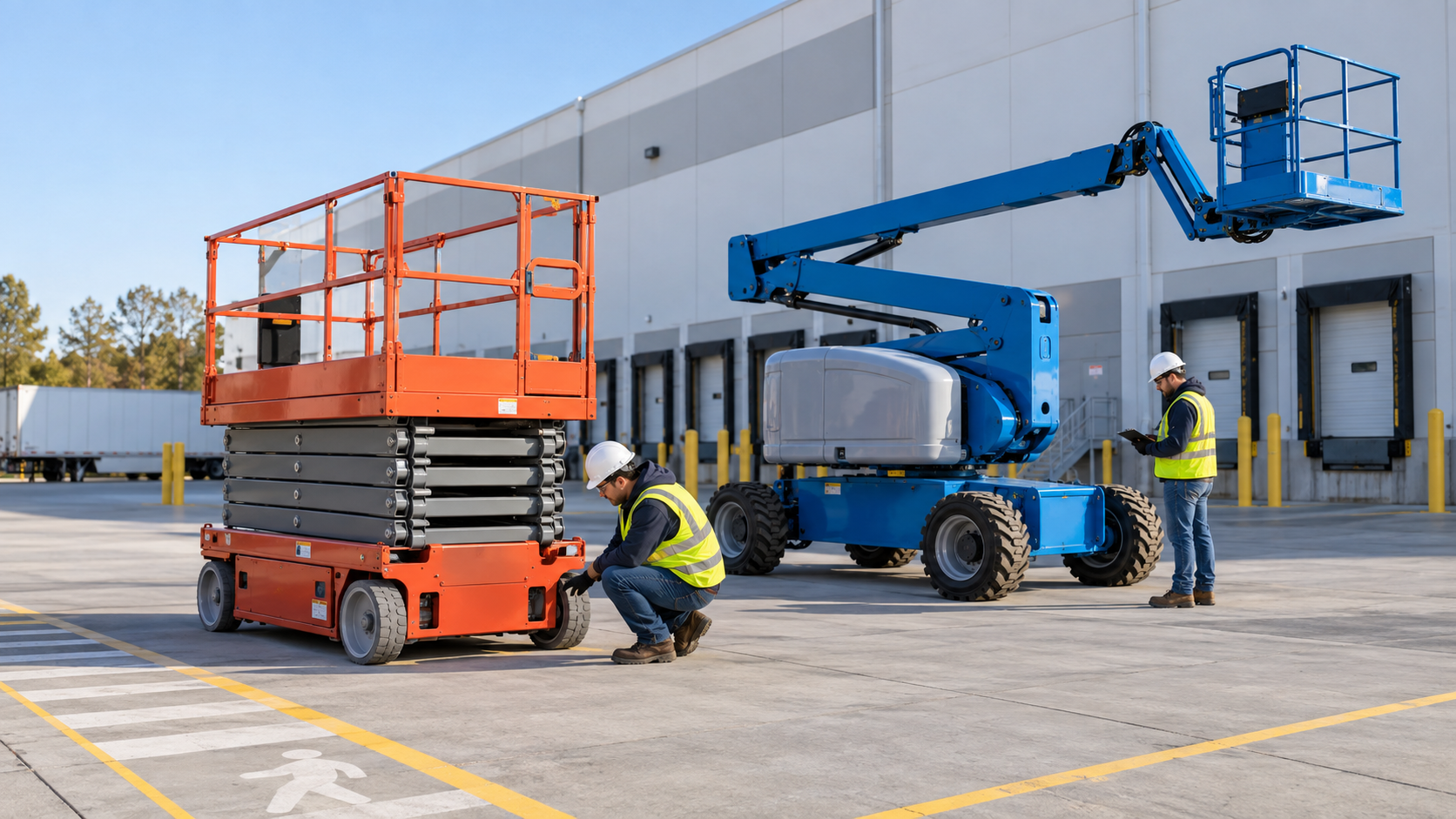
Comprehensive safety awareness training for mobile vertical and mobile boom platforms, built around the current ANSI/SAIA A92 framework and applicable OSHA requirements.
LanguagesEnglish and Spanish available · Russian in preparation
CompletionVerifiable awareness certificate with QR code
Training boundary
Awareness is the starting point.
All three are needed for a defensible operator program. This online course completes the theory stage and prepares the employer's hands-on evaluation.
1
Online theory
Lessons, scenarios, tables, module checks, and a 30-question final assessment.
2
Hands-on training
Controls, inspection, travel, positioning, emergency systems, and category-specific practice.
3
Practical evaluation
Separate observed competency decisions for 3A and 3B, followed by employer authorization.
Learning outcomes
Plan. Inspect. Control. Demonstrate.
Operator theory for real workplace decisions.
01
Classify the platform
Distinguish Type 3 Group A mobile vertical platforms from Type 3 Group B mobile boom platforms.
02
Inspect and plan
Complete pre-start, function, route, ground, work-envelope, rescue, and communication decisions.
03
Operate within limits
Control stability, capacity, travel, wind, clearance, falls, electricity, and entrapment hazards.
04
Know the boundary
Separate online theory completion from hands-on evaluation and employer authorization.
Standards framework
Current ANSI/SAIA A92 foundation.
Official sources are linked for reference. The course paraphrases concepts and does not reproduce copyrighted standards text.
Identify the machine, governing framework, and training boundary before operation.
MEWP language and the A92 framework~12 min
Responsibilities and qualification boundaries~11 min
02
Risk assessment, machine selection, and rescue planning
Match the platform to the task and prepare for foreseeable loss of control.
Workplace risk assessment~12 min
Rescue and emergency plan~11 min
03
Inspection, function tests, and familiarization
Confirm the machine is fit for service and learn the specific controls before use.
Pre-start inspection~12 min
Function tests and model familiarization~11 min
04
Stability, capacity, setup, and travel
Keep the center of gravity, forces, route, and machine limits under control.
Stability and load management~12 min
Safe travel and positioning~11 min
05
Falls, electricity, entrapment, and overhead hazards
Apply hazard-specific controls around the platform's full operating envelope.
Platform conduct and fall protection~12 min
Electrical, crushing, and overhead exposure~12 min
06
Type 3 Group A — mobile vertical platforms
Control scissor-lift and vertical-mast hazards without treating them as simple rolling scaffolds.
3A operation and workplace controls~11 min
3A case studies and decisions~9 min
07
Type 3 Group B — mobile boom platforms
Manage outreach, tail swing, platform movement, fall protection, and positioning.
3B setup and operation~12 min
3B case studies and spotter communication~10 min
08
Practical evaluation, records, and continuing control
Convert theory into documented hands-on competency and safe authorization.
Hands-on training and practical evaluation~12 min
Documentation, certificate, and final field guide~10 min
09
Applied workplace decisions and verification
Machine inspection, route verification and emergency readiness. Six case-based lessons with explanations and knowledge checks.
Replacement equipment needs its own familiarization~6 min
Floor capacity is not proven by a flat surface~6 min
Capacity includes people, tools and the task~6 min
Control the ground area as well as the platform~6 min
Rescue readiness must survive a change of shift~6 min
A defect report ends with a controlled release~6 min
Certificate scope
OSHA-aligned theory training informed by ANSI/SAIA A92.20-2021, A92.22-2021, and A92.24-2018 (R2026). Completion does not authorize MEWP operation. The employer must provide applicable hands-on training, category-specific practical evaluation, model familiarization, workplace hazard assessment, rescue planning, and authorization.