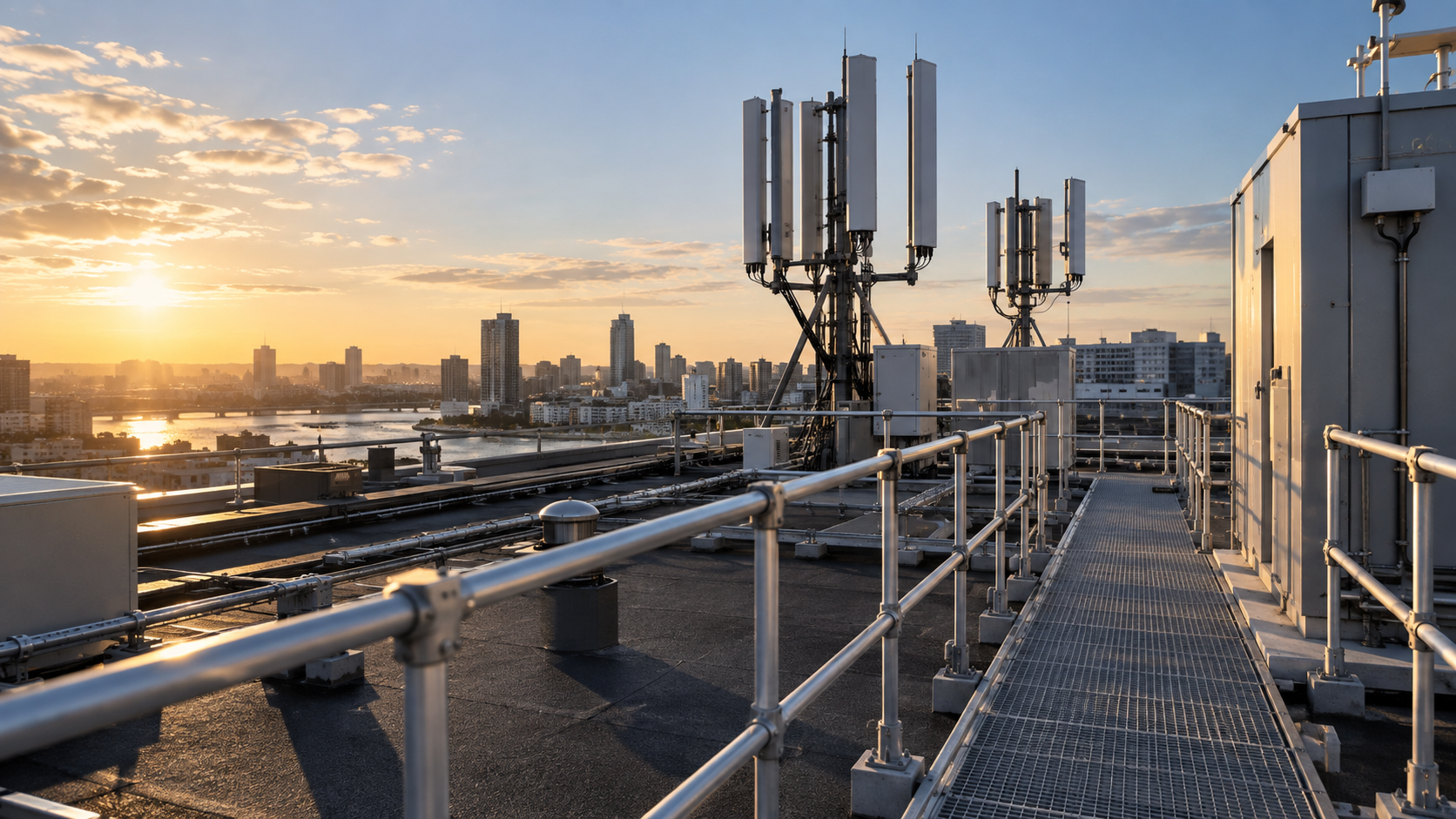
Practical RF awareness for people working around transmitting antennas and other radiofrequency sources. Learn to recognize controlled areas, interpret site instructions, coordinate with the responsible operator, respect exposure controls, and respond to alarms or unexpected conditions. Designed for telecom, broadcast, maintenance, utility, construction, and facility personnel. Completion is not authorization to enter a restricted area, operate a transmitter, or perform an RF compliance survey.
Illustrative setting · actual access boundaries require a site assessment
Training time~2 hours 36 minutes including activities
Learning contentOSHA RF guidance · FCC · IEEE C95
Final assessment20 random questions · bank of 40
Passing attempts3 attempts
LanguagesEnglish and Spanish available · Russian in preparation
CompletionAwareness completion record
Practical RF awareness
Recognize the source. Respect the boundary.
Plan approximately 156 minutes: 141 minutes for reading, checklist exercises and discussion, plus a 15-minute assessment. This is an estimated learning schedule, not a mandated OSHA minimum. Read each scenario, write your decision, then compare it with the suggested response.
Sources include OSHA RF guidance, FCC exposure rules and the IEEE C95 framework. IEEE C95.7-2022 updates the earlier 2014 safety-program reference. This is not transmitter-operator authorization or RF-surveyor qualification.
Learning outcomes
Make the next decision a safer one.
1
Recognize RF sources
Identify sources and distinguish unknown status from confirmed controls.
2
Respect exposure boundaries
Use the site assessment instead of a universal distance rule.
3
Coordinate safe work
Communicate source restrictions, routes, alarms and shift handoffs.
4
Respond without added risk
Withdraw safely, summon help and report facts.
Course outline
Seven workplace-focused modules
1
RF fundamentals and workplace sources
Recognize RF sources without relying on appearance, sound, or bodily sensations.
RF energy, frequency, and nonionizing radiation
Antennas, industrial sources, and shared sites
2
Exposure assessment and controlled access
Explain why a site-specific assessment is required instead of a universal distance rule.
What determines an exposure boundary
Public and occupational exposure conditions
3
Signs, boundaries, and job planning
Use warning information and pre-job coordination before entering controlled areas.
Read the complete warning and access instructions
Pre-job briefing and change management
4
Safe operations and exposure controls
Follow authorized controls without improvising transmitter shutdowns or protection.
Coordinate shutdowns and prevent unexpected restoration
Monitoring and PPE limitations
5
Combined hazards and workplace scenarios
Recognize when other hazards require additional controls or specialist review.
Electrical, fall, thermal, and access hazards
Medical devices and other special concerns
6
Abnormal conditions, reporting, and final review
Stop, withdraw safely, report, and avoid an uncontrolled rescue attempt.
Respond to an alarm or unexpected condition
Document the event and confirm conditions before restarting
Source library
Official reference library
Original educational content. The applicable rules and current site exposure assessment control workplace decisions.